Three Submarines, Two Decades, One Vague Hope: A Modest Appreciation of AUKUS
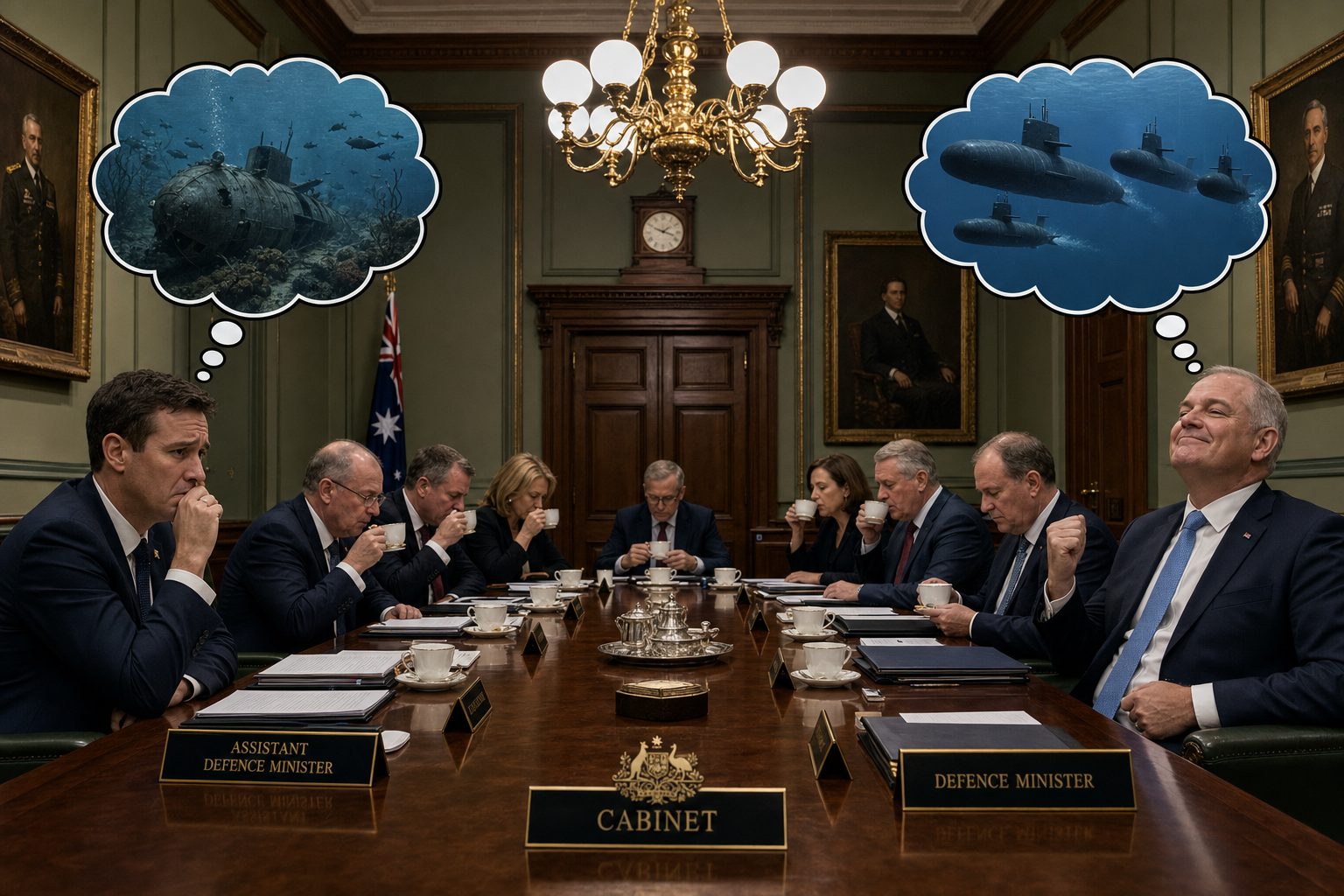
There is, I am told by Senator James Paterson on the wireless this Thursday morning past, a "very grave risk of a capability gap emerging over the next two decades" in Australia's submarine fleet. A capability gap, you understand, is not the same as having no submarines. A capability gap is the period during which one has submarines that no longer work, while also possessing submarines that do not yet exist. It is the precise interval in which a hostile naval power might politely choose to take an interest.
Australia's plan, as I understand it from Senator Paterson's exposition, runs as follows. We currently operate six Collins-class submarines, which were commissioned in the 1990s and which require, every now and then, a sort of grand mechanical refurbishment known as a "life-of-type extension". This is a marvellous euphemism, the maritime equivalent of a man in his late seventies announcing he has decided to take up jogging. The Collins are reportedly receiving theirs slowly and badly, with the consequence that some of them may not be available in the late 2020s.
The next item on the menu is the Virginia-class submarine, of which we are to acquire several from the Americans. There are, the Senator notes, "risks on the delivery timetable", which I take to mean that the Americans are not entirely certain they will give us any. The Americans build approximately 1.2 Virginia-class submarines per year, and they need 2.0 just for themselves. The arithmetic is not flattering.
The third element is the most ambitious. We are to construct, in partnership with Britain, a new submarine called the SSN-AUKUS. This is, in Senator Paterson's words, "one of the most ambitious industrial exercises we've ever undergone as a country". I take a quiet professional satisfaction in the deployment of the word "exercises", which in British military parlance is the term for a manoeuvre that has not yet been attempted. The SSN-AUKUS does not currently exist. It will exist, optimistically, in the 2040s. By that point I personally shall be a small jar of ash in a churchyard in Oxfordshire, and I rather suspect the same will be true of the South China Sea.
The Senator's preferred response to this situation is what he calls "prudent contingency plans of supplementary capabilities". This is, again, a wonderful phrase. Contingency plans of supplementary capabilities. It is the political-class equivalent of a chap arriving at a dinner party with three different bottles of wine because he is not entirely certain whether the hostess intends to serve fish, beef, or a regretful sort of stew.
He is also "deeply worried" about three critical infrastructure projects, the names of which he does not specify, the details of which the Defence Department declined to provide him, and the budgets for which appear to have been written in pencil. There is something genuinely English about all of this — the careful diction, the polite alarm, the impeccable manners with which one announces that the building is on fire.
What we appear to have, then, is a defence policy in which we are about to spend, conservatively, three hundred billion dollars on a fleet of submarines, two-thirds of which we cannot yet build and one-third of which we cannot yet keep running. The Labor government's response is to make cuts. The Coalition's response is to express grave concern about the cuts. The submarines themselves, being inanimate, have no opinion.
I shall watch developments with the particular sort of attention I usually reserve for amateur theatricals. The performances are committed. The script is poor. And the curtain will rise, one suspects, regardless of whether anyone is ready.
X post (266 chars):
James Paterson is "deeply worried" about AUKUS. So is anyone who has noticed Australia plans to spend $300 billion on submarines we cannot yet build, replacing submarines we cannot yet keep running, in a partnership with a country that does not have enough to give us.
RELATED ARTICLES

Our platform covers everything from global events and politics to entertainment, technology, and lifestyle, ensuring you never miss a story.