A Week to Count a Vote Is Not Patience — It Is a Quiet Failure of the State
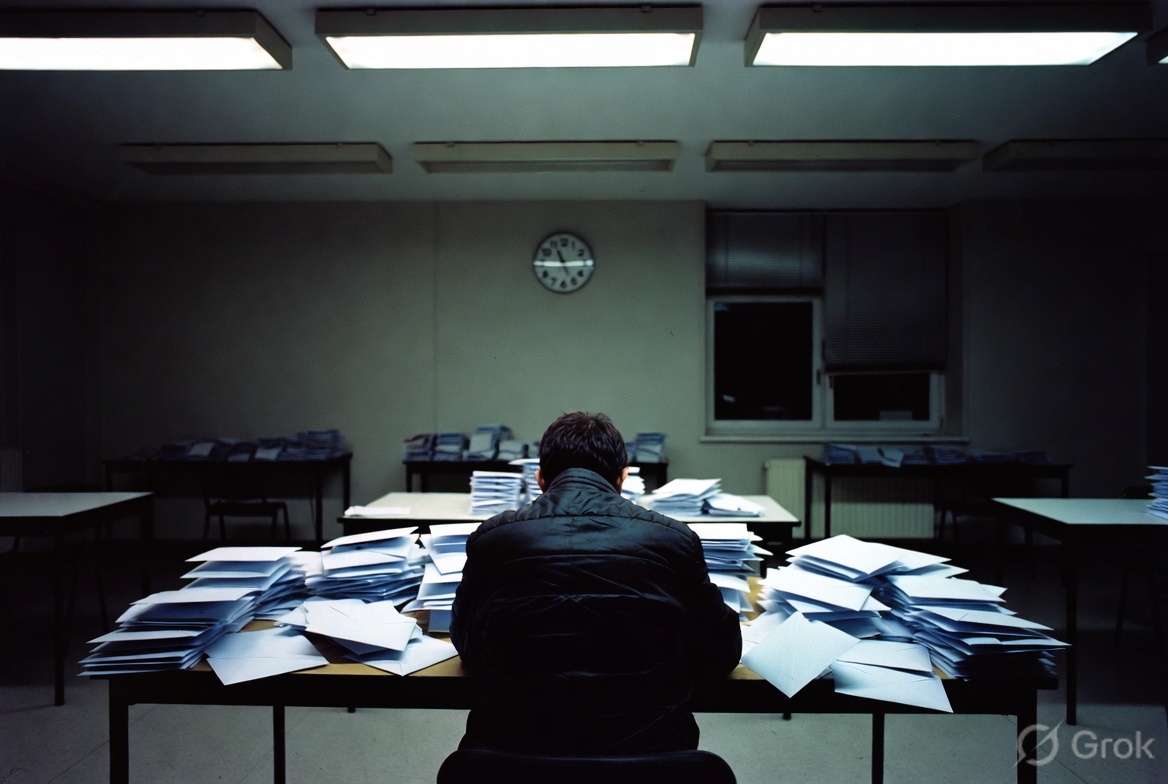
Spare a sympathetic thought for California, the only American state proud enough of its public administration to insist that counting paper takes a fortnight.
The New York Times editorial board, not exactly known for hectoring blue-state legislators, has now declared California's vote-counting regime "wrong" and called on Congress to set Election Day itself as the federal cutoff for mail-in ballots. The Times also wants federal standards for prompt counting. When the in-house paper of America's progressive establishment writes that line, you can take it as confirmation that the wheels have come off something somewhere west of Death Valley.
The reason matters more than the editorial. Spencer Pratt — a man who once mistook a reality television contract for a political career — sat in second place in the Los Angeles mayoral primary until 7 June. By 8 June he had vanished. The WSJ politics newsletter the same day attracted, by Damian Paletta's own admission, an unusual volume of reader correspondence wondering what on earth is going on out there. Conspiracy theories duly followed, because of course they did, because slow counting and conspiracy theories enjoy the kind of natural symbiotic relationship usually reserved for ticks and rangeland cattle.
This is California's defenders making the case for California. The race that prompted the panic was a city primary in the country's second-largest metropolitan area. The voting machines were not destroyed. There was no flood, no fire, no civic insurrection. A perfectly ordinary primary election produced a count that took, by the WSJ's own narrative, the better part of a working week to settle. And in that working week, a public figure rose two places and fell three.
You will have noticed, dear reader, that this is not the only Californian institution currently running at a tempo more appropriate to the late Roman Empire than the modern world. The state's high-speed rail project, conceived in 2008 with a budget of $33 billion and a target completion date of 2020, has now spent the better part of two decades not connecting San Francisco to Los Angeles. The state's homeless population, despite roughly $24 billion in public spending since 2019, has gone up. The state's prison-reform programme produces the country's loudest debates and least convincing statistics. And the vote-counting regime, the most basic mechanical function of a functioning democracy, takes seven days to confirm that yes, the person who got the most votes did, in fact, get the most votes.
The defence offered for all of this is invariably some variant of the same line: California is large, California is complicated, California has unique needs. The implication being that smaller, less complicated, less unique states like Florida — which counts its ballots on election night, in front of cameras — must be doing something terribly wrong, or alternatively that the Floridians do not care about the marginalised, or alternatively still that the Floridians have somehow stumbled into competence by accident.
There is a third possibility, which is the one the Times editorial board has very gingerly approached. It is that California has, over twenty years of one-party government, built a public sector designed to produce process rather than outcomes. The process is the point. The longer the count, the more virtuous the count. The more elaborate the procedure, the more legitimate the procedure. Speed, efficiency, accountability — these are all considered slightly vulgar concerns, more appropriate to the private sector or to states that vote Republican.
Australia, take note. We count our votes on election night, more or less. The Australian Electoral Commission is the most boring agency in Canberra, which is precisely the highest possible compliment. When the Productivity Commission inevitably returns next year with another submission on how to streamline some critical piece of national infrastructure, recall the New York Times's quiet 10 June verdict on the Californian alternative. It takes them a week to count, and the only thing that explains why is twenty years of unchallenged government.
RELATED ARTICLES


Our platform covers everything from global events and politics to entertainment, technology, and lifestyle, ensuring you never miss a story.