The Poverty Rate Has Collapsed. The Dependency Industry Refuses to Read the Number.
A new Cato research brief, drawing on work by Richard V. Burkhauser and Kevin Corinth published as NBER Working Paper No. 34759, has done what every honest measurement does: it has destroyed a myth.
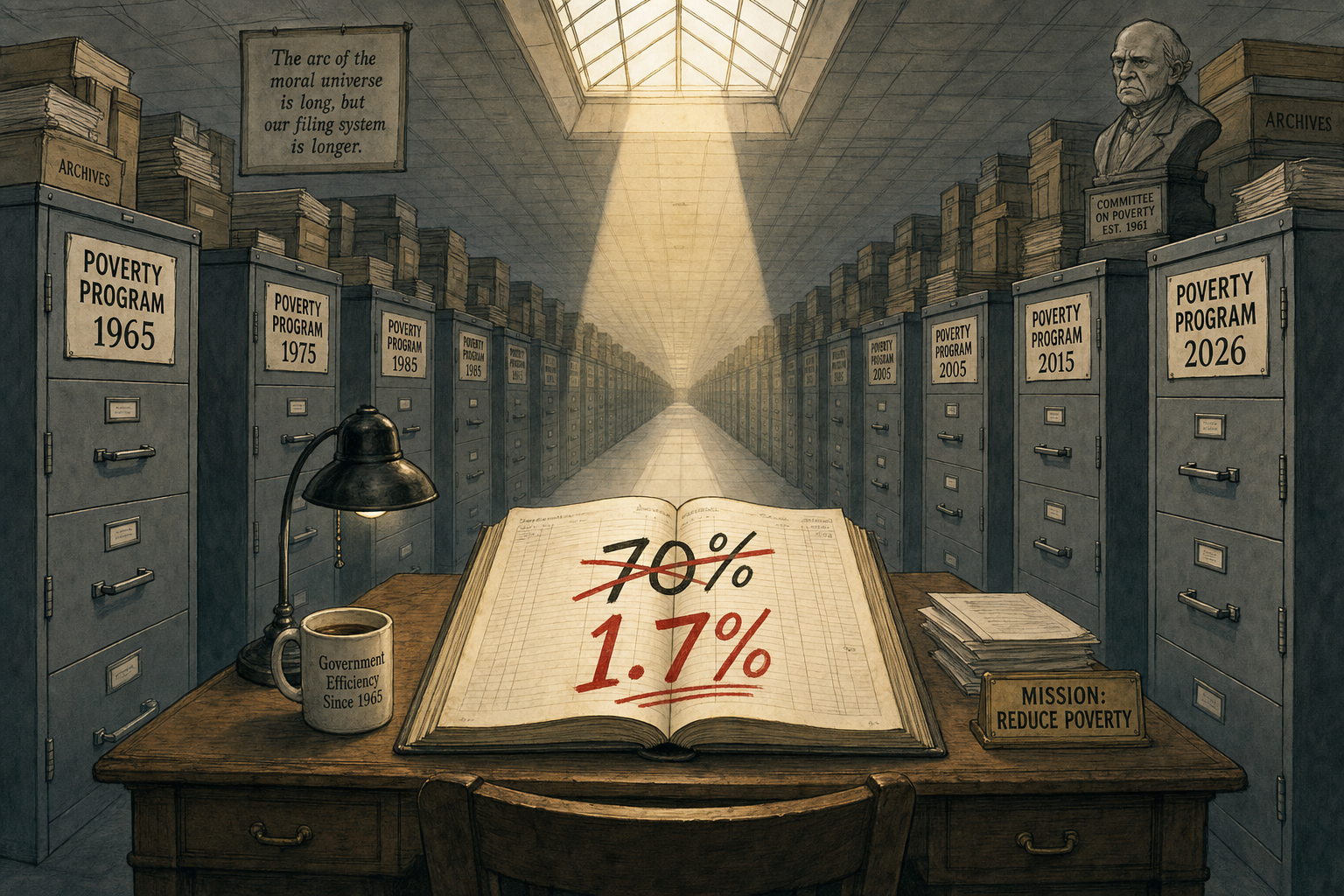
The official American poverty rate in 1939 was 70 per cent. By 2023, measured with the same income definition extended consistently across eighty-four years and adjusted for the actual prices Americans pay and the actual transfers they receive, it had fallen to 1.7 per cent.
Not 11. Not 12.8. One point seven.
This is not a quibble about technique. This is the central economic fact of the modern era, and it has been hidden in plain sight for two generations by a measurement convention designed in 1963 and frozen in amber ever since. The official poverty line ignores most non-cash transfers, ignores the value of health insurance, uses the wrong inflation index, and counts as 'poor' tens of millions of Americans whose actual material consumption exceeds the median consumption of working-class families in 1960.
There is a reason this measurement persists. There is a reason every welfare bureaucracy, every advocacy group, every politician who runs on compassion as a profession, prefers the broken number to the accurate one. The broken number sustains them. The accurate one would dissolve them.
If poverty in America has been functionally defeated — if 98.3 per cent of Americans live above the poverty line as originally defined — then the entire architecture of expanded entitlement, of permanent expansion of the welfare state, of the moral case for redistribution from the productive to the dependent, collapses. There is no humanitarian emergency to manage. There is only a managerial class that has, for sixty years, been managing a problem it had already solved.
This is what the welfare state was never supposed to do. It was sold as a temporary scaffolding against the destitution of the 1930s. It became a permanent industry, employing more people than coal mining ever did, claiming a share of GDP larger than the entire defence budget, and producing — by its own measurement — no improvement at all. Because improvement was not the goal. Self-perpetuation was the goal.
The men and women who built modern America did not need the official poverty rate to fall. They built the wealth that caused it to fall. Edison did not consult the Census Bureau before lighting Manhattan. Carnegie did not check the Gini coefficient before laying steel. They produced, and production lifted millions of people whose grandchildren now sit in faculty lounges arguing that production is the problem.
The Cato finding is a moral document disguised as a statistical one. It says: the system you say is broken is not broken. The wealth you say has not been created has been created. The people you say are suffering, by your own original definition, are not suffering. You may dislike this. You may need it not to be true. The number does not care.
The proper response to this brief is not another working paper. It is the dismantling of every programme that justifies itself by reference to a falsehood. That is what intellectual honesty requires. It is also what no committee in Washington will ever vote for, because no committee in Washington ever voted itself out of existence.
The numbers have already done so. We need only the courage to read them.
RELATED ARTICLES



Our platform covers everything from global events and politics to entertainment, technology, and lifestyle, ensuring you never miss a story.